Digital twins from photogrammetry
A workflow for turning overlapping photos into data-infused digital twins, and a map of exactly where the technique breaks.
Modelling complex parts and spaces for a digital twin is slow even for experienced 3D artists. Photogrammetry stitches overlapping 2D photographs into a 3D model through aerotriangulation, which can replace manual modelling when no CAD model exists.
The thesis built that workflow end to end on accessible hardware, tested it across reflective, transparent, featureless, indoor, outdoor and dynamic scenes, and delivered a complete model infused with data and viewable through a web interface.
What I did
- Developed a four-stage workflow: photography, photogrammetry (aerotriangulation and model generation), external retouching, and production of the digital twin with data infusion.
- Generated models in Bentley iTwin Capture Modeler and ContextCapture, and published them in an iTwin Viewer web app with interactive markers and locally stored data embedded in the model.
- Ran controlled capture experiments to establish where reconstruction fails, then tested mitigations and wrote capture guidelines for future adopters.
Where it failed, and the mitigation
- Finding:
Transparent, reflective and featureless surfaces did not reconstruct: a plastic bottle's body went missing and white walls and black shelves could not be located.
Response:Change the surface quality before capture with scanning spray or talcum powder, then restore the glassy material in Blender after export.
- Finding:
Frames extracted from video carry no positional data, so models misaligned.
Response:Add directly taken photographs as a separate photo group so the software can align both sets.
- Finding:
Photos where the camera refocused on something else caused texture and object misalignment.
Response:Hold a manually set focal length, and place a randomised printed pattern under the object to give the software extra tie points.
- Finding:
Outdoors, harsh sunlight baked dark shadows into textures.
Response:Shoot in overcast light, set ISO, aperture and shutter speed deliberately, use polarising filters on reflective surfaces, and post-process every photo identically.
From the bench
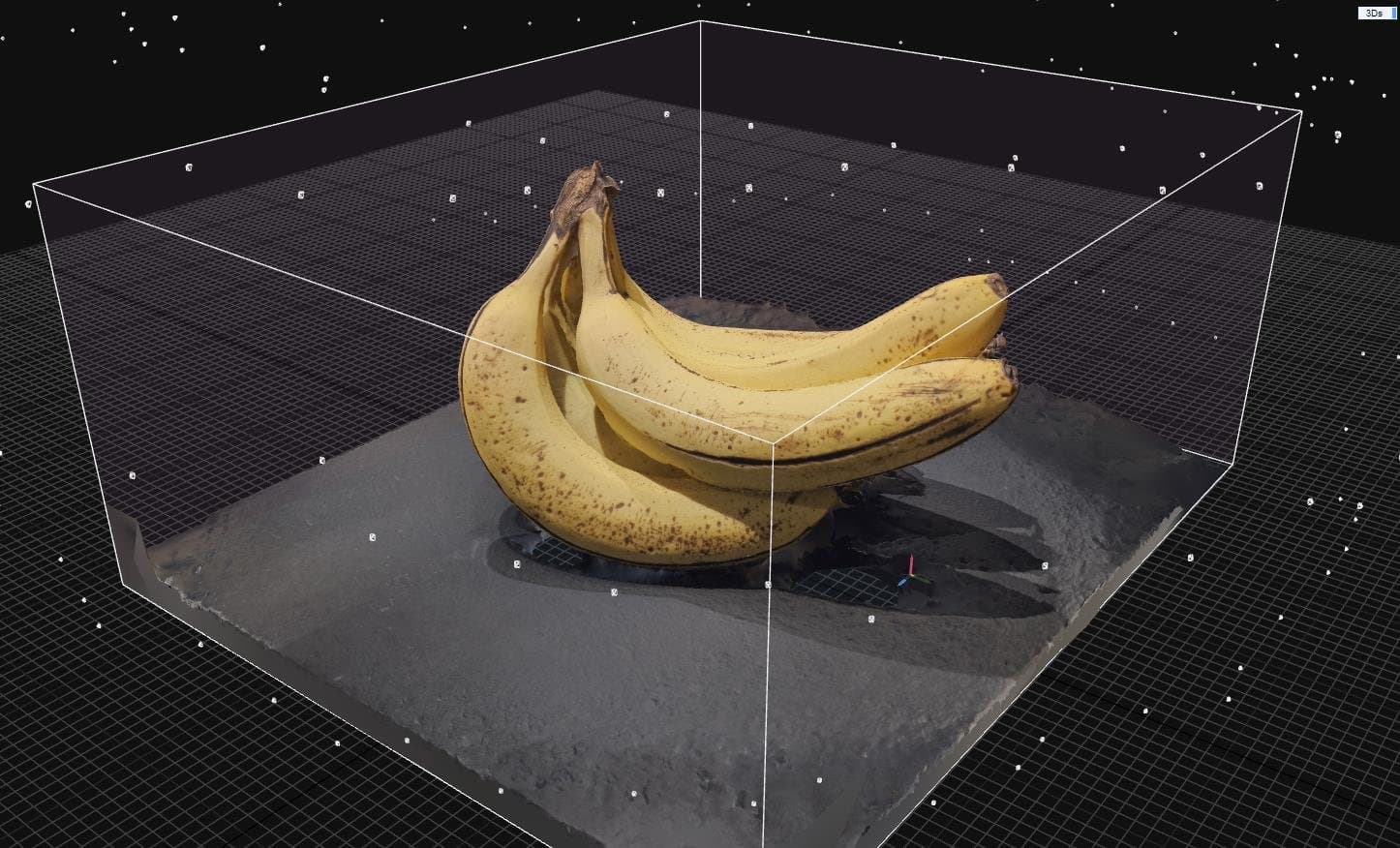
Textured photogrammetry model of a hand of bananas
Interactive marker showing embedded data in the iTwin viewer
Camera positions and tie points after aerotriangulation
Outdoor capture of a building
Reflective test: polished blades on scissors
Glass cup dusted with talcum powder so its surface can be reconstructed